
Worldline vs. SumUp: Which card terminal suits Swiss SMEs?
Worldline and SumUp represent two different philosophies in the Swiss POS market: Worldline with its Interchange++ model and TWINT support, SumUp with its fixed blended pricing and simple onboarding – but without TWINT. This guide compares both concretely for Swiss SMEs.
Published:
Last updated (content):
Last updated (prices):
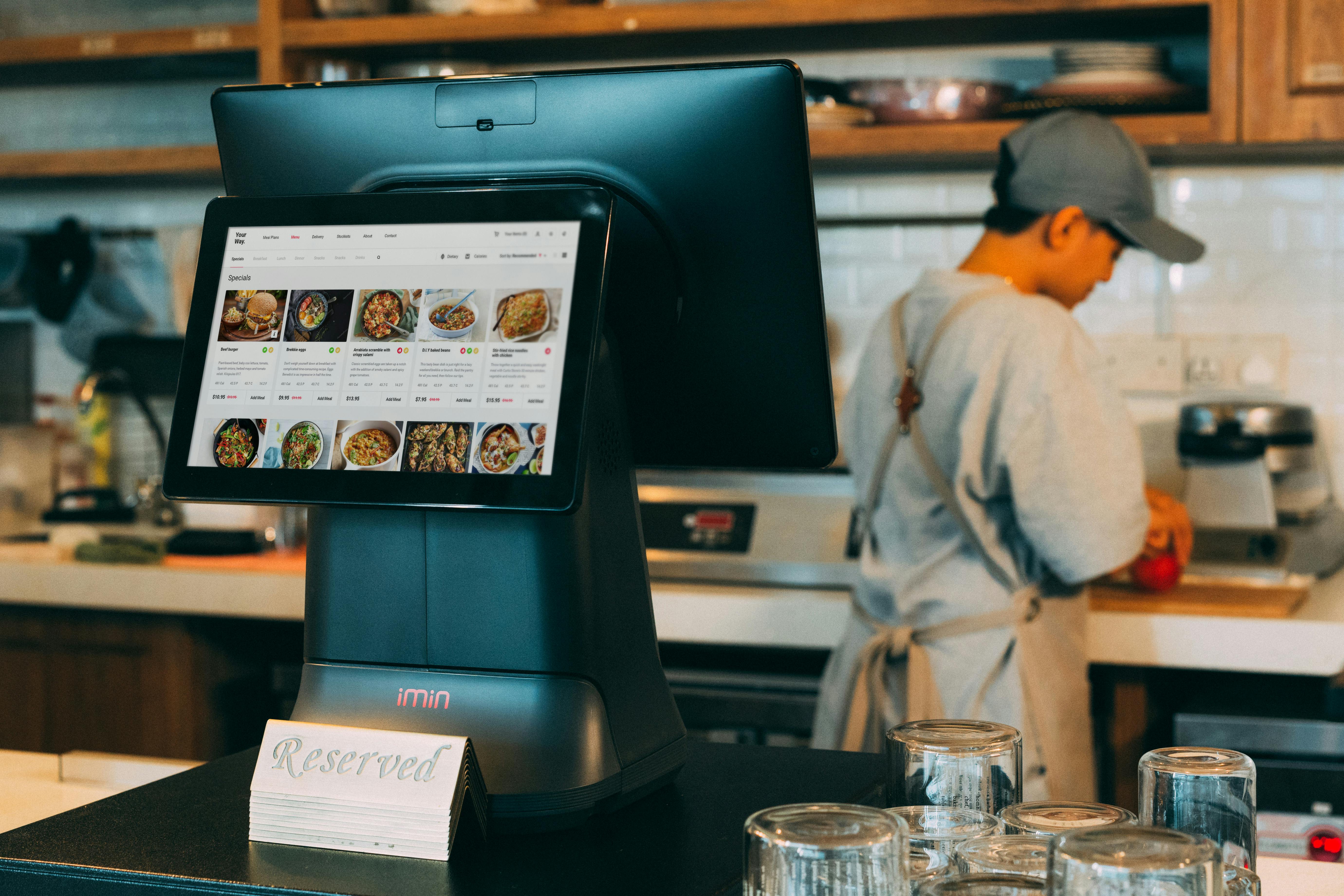
Worldline and SumUp represent two fundamentally different philosophies in the Swiss POS market: Worldline is the established market leader with an Interchange++ model and Swiss roots – SumUp is the global newcomer with a flat-rate pricing model and simple onboarding. For Swiss SMEs, the question is: Which model fits your type of business?
This guide compares Worldline and SumUp specifically for day-to-day Swiss POS operations: fee structure, payment methods, TWINT availability, and onboarding effort – so you know which provider is the better choice for your situation.
1. Two Worlds: Interchange++ vs. Blended Pricing
The fundamental difference between Worldline and SumUp is not a product feature – it is the fee logic.
Worldline uses Interchange++: The fee per transaction is made up of the interchange fee of the card network (dependent on card type and origin), the Worldline service fee, and any surcharges. How much a transaction costs depends on which card your customer pulls out. A Swiss Maestro debit card costs less than a British Visa credit card.
SumUp uses Blended Pricing: A flat rate applies to all debit cards (1.50% Standard, 0.99% Plus), another to all credit cards (2.50% Standard, 0.99% Plus). Non-EU cards and commercial cards cost 1.99% in the Plus plan. No surcharges, no interchange component – whatever is stated on the pricing page is exactly what you get on the monthly invoice.
What this means for the monthly invoice
With Worldline, the invoice contains a list of transaction items with different fee rates depending on card type and origin. For a business with a mixed customer base – Swiss debit cards, international credit cards, occasional commercial cards – the monthly fee is only known after the event.
With SumUp, the month is predictable in advance: If you know what percentage of your turnover is processed via debit and credit cards, you can calculate the fees beforehand down to the exact EUR.
2. Fee Comparison: How much a transaction costs
The following table shows the effective costs for a EUR 30 ticket in typical scenarios (as of May 2026). Worldline values are estimates based on the public price sheet plus typical interchange benchmarks:
Scenario (EUR 30 Ticket) | Worldline (estimated*) | SumUp Standard | SumUp Plus | Difference |
Swiss debit card | ~EUR 0.30–0.50 (variable) | EUR 0.45 (1.50%) | EUR 0.30 (0.99%) | SumUp Plus cheaper |
Swiss credit card | ~EUR 0.50–0.80 (variable) | EUR 0.75 (2.50%) | EUR 0.30 (0.99%) | SumUp Plus significantly better |
TWINT | EUR 0.15 (minimum fee) | ✗ not possible | ✗ not possible | Worldline (only option) |
Foreign credit card (EU) | ~EUR 0.59–0.89 (+0.98% surcharge) | EUR 0.75 (2.50%) | EUR 0.60 (1.99%) | Similar |
Non-EU card (Tourist) | ~EUR 0.69–1.09 (+1.30% surcharge) | EUR 0.75 (2.50%) | EUR 0.60 (1.99%) | SumUp Plus slightly better |
* Worldline values are based on the public price sheet (from February 2026) plus typical interchange benchmarks. Effective costs depend on the individual Comerciante agreement.
Striking: SumUp Plus (EUR 29/month) beats Worldline significantly on credit cards – 0.99% vs. Interchange++ means a difference of around EUR 0.50–0.80 in favor of SumUp for a EUR 100 credit card transaction. For very small amounts and Swiss debit cards, Worldline can be cheaper due to the low interchange.
3. TWINT: The crucial Swiss difference
Here the paths clearly diverge: Worldline supports TWINT at the POS terminal – with a minimum fee of EUR 0.15 per transaction according to the public price sheet. SumUp does not support TWINT.
For Swiss businesses with local clientele, this is not a minor detail. TWINT is the most widely used mobile payment method in Switzerland. A business without TWINT loses customers who would rather go to the competition than pay by card – regardless of how low the card fees are.
When TWINT can be omitted without consequences
There are scenarios in which TWINT actually does not matter: purely tourist businesses with no local Swiss clientele, international trade fairs and conferences with foreign visitors, or businesses in regions with very low TWINT adoption. For everyone else, SumUp's TWINT gap is a structural issue.
4. Total Monthly Costs: Scenarios for Swiss SMEs
The following table shows three typical SME scenarios (as of May 2026). POS transactions, excluding online payments:
Scenario | Worldline (estimated*) | SumUp Standard | SumUp Plus (EUR 29) |
|
EUR 3'000/month 80% debit, 20% credit no TWINT | ~EUR 60–80 | EUR 72 | EUR 29 + EUR 29.70 = EUR 58.70 |
|
EUR 5'000/month 70% debit, 30% credit no TWINT | ~EUR 100–140 | EUR 112.50 | EUR 29 + EUR 49.50 = EUR 78.50 |
|
EUR 5'000/month with 30% TWINT | ~EUR 90–120 (TWINT included) | not possible (no TWINT) | not possible (no TWINT) |
|
EUR 10'000/month 60% debit, 40% credit | ~EUR 180–260 | EUR 230 | EUR 29 + EUR 99 = EUR 128 |
|
From around EUR 3,000 in monthly card sales, SumUp Plus is almost always worth it compared to the standard rate. Worldline remains difficult to compare directly in this table – the Interchange++ model can turn out lower or higher than SumUp's prices depending on the customer mix.
5. Payment methods compared
Beyond debit and credit cards, the two providers differ when it comes to other payment methods:
Payment Method | Worldline | SumUp |
Visa / Mastercard Debit | ✓ | ✓ |
Visa / Mastercard Credit | ✓ | ✓ |
TWINT | ✓ | ✗ |
PostFinance Pay | ✗ | ✗ |
Apple Pay / Google Pay | ✓ | ✓ |
Alipay / WeChat Pay | ✓ | ✗ |
Online Payments | ✓ via Saferpay (separate) | ✓ 2.50% flat rate (included) |
Recurring Payments | ✗ | ✗ |
Payment Links | limited | ✓ |
Worldline has a clear advantage here in terms of Asian payment methods (Alipay, WeChat Pay) – relevant for businesses in tourist locations with Chinese clientele. SumUp counteracts this by offering Payment Links as a digital payment tool, which is useful for small businesses without a full web shop integration.
6. Hardware: Rental vs. Purchase
SumUp sells its hardware one-off: The SumUp Air starts at EUR 49, the SumUp Solo at EUR 99. No monthly rental fee. For seasonal businesses or Comerciantes with very low volume, this is financially attractive – the hardware pays for itself quickly.
Worldline works with terminal rental or purchase, depending on the Comerciante agreement. The conditions are negotiated individually. A comparison is not possible without a concrete quote.
Important for the comparison: With SumUp (standard rate), no monthly fixed fee is added to the card fee. If you generate low sales, you pay correspondingly little. This makes SumUp the cheapest entry model for businesses with less than EUR 2,000 monthly card sales.
7. Onboarding: Negotiation vs. Self-Registration
Worldline primarily targets larger Comerciantes. Onboarding runs via an individual quote – prices and conditions are negotiated. For a food truck or a small beauty salon, this process is often disproportionately complex.
SumUp enables self-registration without negotiation: create an account, purchase hardware, activate terminal. For new start-ups or seasonal businesses that want to get going quickly, this is a distinct advantage. The flip side: individual conditions for high volumes are only available from EUR 10,000 in monthly sales.
8. Overall Decision: When to choose which provider
Aspect | Worldline | SumUp | Advantage |
Pricing model | Interchange++ (variable) | Blended Pricing (fixed) | SumUp (transparency) |
Debit POS | Interchange + service fee (min. EUR 0.20) | 1.50% (Standard) 0.99% (Plus) | SumUp Plus for high volumes |
Credit POS | Interchange + service fee (min. EUR 0.20) | 2.50% (Standard) 0.99% (Plus) | SumUp Plus significantly cheaper |
Non-EU / Commercial cards | INTRA +0.98% INTER +1.30% +1.30% Commercial cards | 2.50% Standard 1.99% Plus | Similar, Worldline at very high vol. |
TWINT POS | ✓ (min. EUR 0.15) | ✗ not available | Worldline |
PostFinance Pay | ✗ | ✗ | None |
Online Payments | Saferpay separate 1.70% + EUR 0.19 | 2.50% flat rate (included in plan) | SumUp (simpler) |
Hardware | Rental or purchase (individual) | Purchase EUR 49–199 | SumUp (cheap entry) |
Onboarding | Individual quote, days–weeks | Immediate, no negotiation | SumUp |
TWINT as Swiss method | ✓ | ✗ | Worldline |
Target group | Enterprise / Wholesale | SMEs, sole traders | SumUp for small SMEs |
For whom Worldline makes sense
Worldline remains the right choice if TWINT is indispensable and no alternative Swiss PSP is desired, if Alipay or WeChat Pay are relevant, or if a business has already invested in the Worldline ecosystem (registers, ERP). For very high volumes consisting predominantly of Swiss debit cards, the Interchange++ model can also be cheaper than fixed blended rates.
For whom SumUp makes sense
SumUp is the most straightforward solution for Swiss SMEs with no TWINT requirement: transparent fixed prices, low-cost hardware purchase, immediate onboarding. SumUp Plus (EUR 29/month) with 0.99% for all cards is particularly hard to beat from EUR 3,000 in monthly sales – provided no TWINT is needed.
Worldline is a better fit if... | SumUp is a better fit if... |
TWINT is indispensable (Swiss clientele) | No TWINT is needed (e.g. purely tourist business) |
Very high volume with existing Worldline ecosystem | Quick start without individual quote is desired |
Alipay / WeChat Pay relevant (Asian clientele) | Low-cost hardware through one-off purchase (EUR 49+) |
Enterprise cash register system integration required | Monthly cancellable plan with no long-term commitment desired |
Checklist: Worldline or SumUp – which fits my business?
Do I need TWINT? (Yes → Worldline or Payrexx, not SumUp)
How high are my monthly card sales? (Under EUR 3,000 → check SumUp Standard)
How large is my share of credit cards? (High → SumUp Plus with 0.99% is attractive)
Do I have international customers with non-EU cards? (Yes → compare SumUp Plus 1.99% vs. Worldline +1.30% surcharge)
Do I have Asian customers (Alipay/WeChat)? (Yes → Worldline)
Do I want to get started quickly without negotiation? (Yes → SumUp)
Do I need Online + POS from a single system? (Yes → neither SumUp nor Worldline is ideal)
Do I have an existing Worldline cash register system? (Yes → check migration costs)
For Swiss SMEs needing TWINT, PostFinance Pay, transparent fixed prices, and Online + POS from a single system, neither Worldline nor SumUp is the complete solution. Payrexx combines Blended Pricing (Debit 0.95% + EUR 0.15, Credit 1.25% + EUR 0.15, TWINT 1.25% flat) with online integration from the same account – all under the standard plan for EUR 19/month.
Frequently asked questions: Worldline vs. SumUp Switzerland
Does SumUp have TWINT in Switzerland?
No. SumUp does not support TWINT or PostFinance Pay in Switzerland. For businesses with a Swiss regular customer base, this is a significant disadvantage.
View detailed response
Which provider is cheaper – Worldline or SumUp?
It depends on the customer mix. SumUp Plus (EUR 29/month) is often cheaper at 0.99 % for all cards with medium to high turnover. For small amounts and Swiss debit cards, Worldline may be cheaper due to low interchange.
View detailed response
How much does SumUp Plus cost in Switzerland?
SumUp Plus costs EUR 29/month with 0.99 % for all debit and credit cards on site. Non-EU-cards as well as corporate and premium cards cost 1.99 %. Online payments 2.50 % flat.
View detailed response
Does Worldline support online payments?
Yes, via Saferpay – a separate product with its own contract. Fee: 1.70 % + EUR 0.19 per online transaction. POS and online are managed separately.
View detailed response
How quickly can I get started with SumUp?
Very fast. SumUp enables self-registration without negotiation – create an account, buy hardware (from EUR 49), activate the terminal. Typically under an hour, excluding hardware delivery time.
View detailed response
Can I set up recurring payments with SumUp?
No. SumUp does not offer native subscription or recurring payment functions. Worldline also does not offer this in its standard POS. A different provider is required for subscription payments.
View detailed response
What is the biggest disadvantage of SumUp for Swiss SMEs?
The lack of TWINT support. For businesses with a regular Swiss clientele, this means that a relevant part of the preferred payment method cannot be accepted.
View detailed response
What is the biggest disadvantage of Worldline for SMEs?
The lack of price transparency. Worldline does not communicate public end prices – the Interchange++ model makes the monthly invoice difficult to predict, and the onboarding process requires an individual offer.
View detailed response